Note
Go to the end to download the full example code.
Estimating 3-D orientation, then fitting a nested variogram#
fit_anisotropy() fits sills and anisotropic
ranges for a fixed orientation – it bins along axes derived from the
supplied azimuth / dip / plunge. When the orientation is unknown,
estimate it first and then fit the shape. This is the robust, two-step
workflow for a nested 3-D model:
Estimate orientation with
estimate_aniso_angle(), a weighted-PCA of the near-origin lag cloud. It returns all three angles(azimuth, dip, plunge)and the(anis1, anis2)minor/major axis ratios.Fit the model with
fit_anisotropy()at the estimated orientation.
A single realisation’s empirical cloud is too noisy for the PCA, so several realisations are pooled first (the same denoising trick as the 2-D nested example).
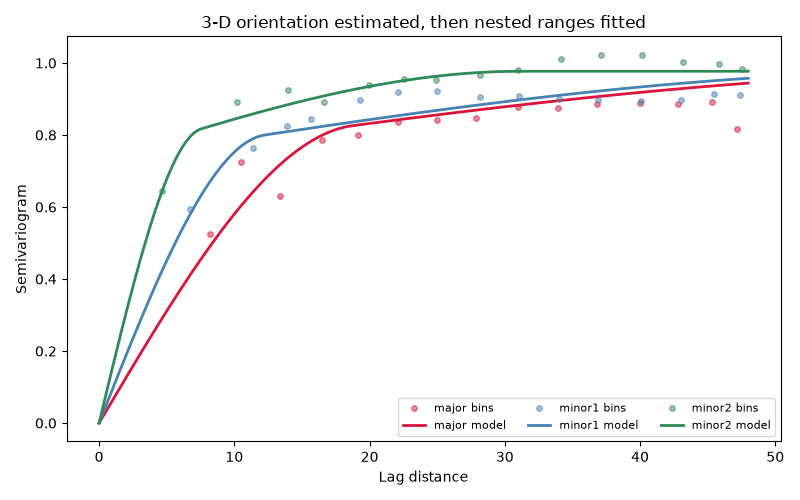
What is and isn’t well determined here is itself the lesson:
The orientation (major axis especially) is recovered well – reported as axis-direction alignment with the truth.
plunge– the twist of the minor axes about the major axis – is the least certain angle.The total sill and the fitted curves match the data, but the split of that sill and range between the two nested structures is only weakly identifiable: two spherical components with similar shapes trade off, so the per-component numbers need not match the truth even when the overall model does. This non-uniqueness is intrinsic to nested fitting, not a solver bug.
The synthetic field has a known nested model, simulated by Cholesky factorisation of the model covariance.
import matplotlib.pyplot as plt
import numpy as np
import pandas as pd

from krigekit import Kriging, VariogramModel
from krigekit.variogram import estimate_aniso_angle, rotation_matrix_3d
Ground-truth nested model#
Two strongly anisotropic spherical structures share one triaxial orientation.
# Ranges are kept well above the grid spacing (5) so they are resolvable, and
# the two structures are well separated so the nested fit can split them.
TRUE_ANGLES = dict(azimuth=35.0, dip=22.0, plunge=12.0)
TRUE_SHORT = dict(vtype="sph", sill=0.4, a_major=18.0, a_minor1=11.0, a_minor2=6.0)
TRUE_LONG = dict(vtype="sph", sill=0.6, a_major=45.0, a_minor1=27.0, a_minor2=14.0)

truth = VariogramModel()
truth.set_vgm(nugget=0.0, name="short spherical", **TRUE_SHORT, **TRUE_ANGLES)
truth.set_vgm(name="long spherical", **TRUE_LONG, **TRUE_ANGLES)
VariogramModel(nstruct=2)
Simulate and pool several realisations#
The field is drawn on a regular grid by Cholesky factorisation of the model covariance. Each realisation gives a noisy empirical cloud; pooling them denoises the near-origin structure enough for the orientation estimate.
axis = np.arange(0.0, 60.0, 5.0)
gx, gy, gz = np.meshgrid(axis, axis, axis, indexing="ij")
grid = np.column_stack([gx.ravel(), gy.ravel(), gz.ravel()])

chol = np.linalg.cholesky(
    truth.calc_covariance(grid, grid, pairwise=True) + 1e-8 * np.eye(len(grid)))
rng = np.random.default_rng(3)

CUTOFF = 48.0          # beyond the long range so both structures are resolved
N_REAL = 4
clouds = []
for _ in range(N_REAL):
    value = chol @ rng.standard_normal(len(grid))
    sampler = VariogramModel()
    sampler.set_obs(grid, value)
    sampler.set_vgm("sph", sill=1.0, a_major=30.0, a_minor1=20.0, a_minor2=12.0)
    cloud = sampler.calc_experimental(cutoff=CUTOFF, calc_angle=True, verbose=False)
    clouds.append(cloud)
pooled = pd.concat(clouds, ignore_index=True)
print(f"pooled {len(pooled):,} pairs from {N_REAL} realisations")
pooled 4,188,480 pairs from 4 realisations
Step 1 – estimate the orientation and anisotropy ratios#
estimate_aniso_angle returns (azimuth, dip, plunge) and the minor/major
ratios (anis1, anis2) from a weighted PCA of the pooled cloud.
# Estimate orientation from a *small* near-origin radius -- about half the
# shortest structure's range (short major = 18, so r_max ~ 8).  This is where
# the anisotropy is sharpest; a larger radius reaches into the long structure
# and picks up the grid lattice, which biases the axes (here r_max=14 pulls the
# azimuth to ~42 deg, while r_max~8 recovers ~32 deg vs the true 35 deg).
(azimuth, dip, plunge), (anis1, anis2) = estimate_aniso_angle(
    pooled, dim3d=True, r_max=8.0)

print(f"estimated orientation: azimuth={azimuth:.1f}  dip={dip:.1f}  "
      f"plunge={plunge:.1f}")
print(f"estimated ratios:      anis1={anis1:.2f}  anis2={anis2:.2f}")

true_axes = rotation_matrix_3d(
    TRUE_ANGLES["azimuth"], TRUE_ANGLES["dip"], TRUE_ANGLES["plunge"])
est_axes = rotation_matrix_3d(azimuth, dip, plunge)
print("axis-direction alignment with truth (1.0 = identical):")
for k, axis_name in enumerate(("major", "minor1", "minor2")):
    print(f"  {axis_name:6s}: {abs(float(true_axes[:, k] @ est_axes[:, k])):.3f}")
estimated orientation: azimuth=33.2  dip=19.1  plunge=9.3
estimated ratios:      anis1=0.88  anis2=0.59
axis-direction alignment with truth (1.0 = identical):
  major : 0.998
  minor1: 0.999
  minor2: 0.998
Step 2 – fit the nested ranges at the estimated orientation#
Build the nested template with the estimated angles, seed the minor ranges
from anis1 / anis2, then fit sills and the three ranges per component
with the orientation held fixed.
model = VariogramModel()
p0, lower, upper = [], [], []
for name, major0, lo, hi in (("short spherical", 16.0, 8.0, 30.0),
                             ("long spherical", 42.0, 30.0, 70.0)):
    model.set_vgm("sph", sill=0.5, a_major=major0,
                  a_minor1=0.6 * major0, a_minor2=0.35 * major0,
                  azimuth=azimuth, dip=dip, plunge=plunge, name=name,
                  append=name != "short spherical")
    # seed minor ranges from generic ratios (the PCA anis1/anis2 are biased high)
    p0 += [0.5, major0, 0.6 * major0, 0.35 * major0]
    lower += [0.02, lo, 1.0, 0.5]
    upper += [2.0, hi, hi, hi]

directional = model.calc_directional_average(
    pooled, h_bins=16, cutoff=CUTOFF, angle_tol=22.0, include_minor2=True)
fit = model.fit_anisotropy(directional, p0=p0, bounds=(lower, upper),
                           include_minor2=True, fit_nugget=False,
                           weight_col="count", inplace=True, maxfev=50000)

print("\nNested ranges (fitted vs true -- per-component split is non-unique):")
for comp, spec in zip(model.structure.components, (TRUE_SHORT, TRUE_LONG)):
    print(f"  {comp.display_name:16s} sill={comp.sill:4.2f} ({spec['sill']:.2f})"
          f"  major/minor1/minor2={comp.a_major:5.1f}/{comp.a_minor1:5.1f}"
          f"/{comp.a_minor2:5.1f}  (true {spec['a_major']:.0f}/{spec['a_minor1']:.0f}"
          f"/{spec['a_minor2']:.0f})")
total_sill = sum(comp.sill for comp in model.structure.components)
true_total = TRUE_SHORT["sill"] + TRUE_LONG["sill"]
print(f"  total sill = {total_sill:.2f}  (true {true_total:.2f})   <- well determined")
Nested ranges (fitted vs true -- per-component split is non-unique):
  short spherical  sill=0.73 (0.40)  major/minor1/minor2= 18.7/ 12.2/  7.5  (true 18/11/6)
  long spherical   sill=0.25 (0.60)  major/minor1/minor2= 70.0/ 63.0/ 31.2  (true 45/27/14)
  total sill = 0.98  (true 1.00)   <- well determined
Empirical vs fitted model along the estimated axes#
fig, ax = plt.subplots(figsize=(8.0, 5.0))
colors = {"major": "crimson", "minor1": "steelblue", "minor2": "seagreen"}
names = ["major", "minor1", "minor2"]
for k, axis_name in enumerate(names):
    sub = directional[directional["direction"] == k]
    ax.plot(sub["lag"], sub["variogram"], "o", ms=4, alpha=0.5,
            color=colors[axis_name], label=f"{axis_name} bins")
    h = np.linspace(0.0, CUTOFF, 200)
    curve = model.calc_variogram(np.zeros((h.size, 3)), est_axes[:, k] * h[:, None])
    ax.plot(h, curve, color=colors[axis_name], lw=2.0, label=f"{axis_name} model")

ax.set(xlabel="Lag distance", ylabel="Semivariogram",
       title="3-D orientation estimated, then nested ranges fitted")
ax.legend(ncol=3, fontsize=8)
fig.tight_layout()
plt.show()
Transfer the fitted model to a kriging system#
k = Kriging(ndim=3, nvar=1, verbose=0)
k.set_obs(ivar=1, coord=grid, value=value)
model.apply_to(k, ivar=1, jvar=1)
print(f"\nTransferred {k._nvgm_struct[0, 0]} nested structures to the kriging engine")
Transferred 2 nested structures to the kriging engine
Total running time of the script: (0 minutes 2.504 seconds)